skip to main |
skip to sidebar
According to Blogthings, I have a Type A personality so big it makes other Type A's shrink away from me, I never shy away from adversity, and I love to tackle impossible problems. Failure is apparently not an option for me and I tend to be controlling, leaving nothing to chance.My strength is my bold approach to life. My weakness, I don't accept help.And they can tell all that from my birthdate. Wow :)A quick trawl through some of the other delights Blogthings has to offer revealed that - I am only 52% pure ;),
- I come from Saturn, but should rule Mars (?)
- I have experienced 68% of life (do I want to experience the other 32%?),
- My EQ (emotional intelligence quotient) is 133
- I am 70% left-brained (more accurate than most, that one), but
- my brain is 53% female,
- My kissing technique is Perfect (yep, I'm okay with that one too)
- and I could still pass 8th grade Maths.
Oh, and I feel lazy on Sunday afternoons. And I didn't need a quiz to tell me that.
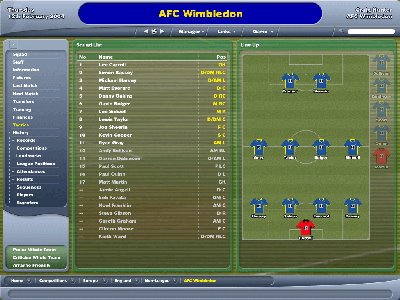
 Am I such a management geek that I have to think about it in my spare time as well?One of my all-time favourite pc games is Football Manager 2005. I was given the game as a present a year or two ago, and started playing it quite seriously while I was off work. After my dedicated "look for work" slot every morning, I used to load up the game, and play Jose Mourinho for a few hours. I was reasonably successful, too, winning the premiership, and the Uefa Cup, although I was knocked out of both the FA cup and the Champions League.Recently, I started a new game, replacing Sven-Goran Erikson as England manager. So far, I have played four games, three of them World Cup qualifiers and won all of them. Perhaps if I get bored of IT, I can go and manage a football team for a living.On second thoughts....
Well, whaddaya know? When I wrote a few weeks ago about the factors that motivate people, apparently Accenture went and conducted a survey about it and discovered that job seekers around the world want a robust rewards programme, regular recognition, opportunites for challenging work and quick career growth.Following on from that, an international survey of HR directors suggests that a company's reputation, culture and the working environment were more important to attracting talent than benefits and compensation, direcly contradicting the opinions of job-seekers.I wonder where the HR directors got their information from, or were they simply trying to hide the fact that their companies don't pay very well?It just goes to show that you can prove anything with a survey, depending on who you ask and the questions you pose.
The feasibility study has more or less concluded. I have spent the last five days with an almost constant headache, despite almost daily 400mg doses of Ibuprofen, frantically typing up all the notes we have taken or printed off the electronic white board (a wonderful invention when it works). The report runs to 30 pages all told, with more to come.The message, however, is not good. The figure that the business were initially given as a 'thumb suck' guesstimate for the entire project will apparently be consumed almost entirely by the application development effort alone. The Capex costs are extra. They were also expecting to have some 'tactical' (euphemism for quick-and-dirty) options available to them in the short-term, but we have little information in that area at the moment. The boys from The Parent Company have not been very forthcoming with their estimates of the actual capacity within the system. We do have some advice for changes within the application that will allow more volume to be processed, but TPC are probably not going to allow us to implement them anytime soon. Frankly, I believe they just don't know how much spare capacity the system has. They are very good at monitoring various parameters and reacting when thresholds are breached, but we are contemplating more than doubling the current volumes within months (not decades) as a tactical move! And then multiplying that by a factor of 5 at least later next year. They are simply not prepared for something like this. Yesterdays meeting with the Business was therefore, extremely interesting. The Director of Product Development and the Head of E-Commerce listened to the presentation, then started grilling Mr T from TPC about why he could not / would not supply any capacity estimates not costs for upgrading the system or anything.His response was that the CEO had instructed them to wait while the TPC's new Exec sponsor made up his mind as to what his requirements were. We felt that that story is a little unlikely. Why would he say "Stop what you're doing on that feasibility study, and don't give them any estimates. Wait until we come up with our requirements and then do it all over again. The Subsidiary, who kicked this thing off in the first place can sit on the sidelines and wait until we're good and ready."? Does that make any sense? I didn't think so.When asked if this was not just a misunderstanding on their part, Mr T had the bald-faced audacity to suggest that perhaps the misunderstanding was not on his part. It's unbelievable! The meeting concluded with him being actioned to escalate the question, and get it clarified. Then Mr T left, and the rest of us sat around shaking our heads and laughing at the sheer absurdity of it all. We gave a hint that the development cost, excluding any infrastructure work on the part of TPC, was likely to be in the region of four million pounds, and the DPD didn't even blink. He knows that this project has the ability to make the company at least that inside the first six months of operation.My hope is that it is all a horrible misunderstanding, and that we can persuade them to assist us with the infrastructure work and use our project as the first phase of their more ambitious effort. But that would be too much like common sense.
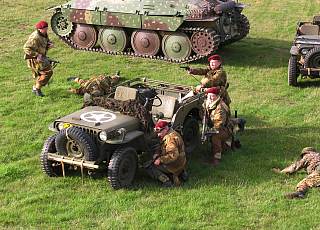
 I stood basking in the warmth of the late afternoon sun yesterday, watching the people go by. A rotund man in English civil war period costume walked along carrying an eighteen foot pike. Behind him strolled a German SS officer, side-by-side with a sergeant in the red beret of the British Parachute regiment of 1944, complete with Sten gun and grenades. They greeted a Russian tank commander, who led a pair of Confederate soldiers dragging a small artillery piece behind them.It was surreal to say the least.The scene was the annual Military Odyssey, held in the middle of Kent County Showgrounds. The 3-day exhibition featured a hundred stalls full of memorabilia, books, photographs, badges, clothing, even genuine weaponry - deactivated of course. There were re-enactments of battles from numerous periods in history, from jousting tournaments, English and American Civil War scenes through a Wild West shootout, to Vietnam and WWII re-enactments. The finale, a very noisy half-hour re-enactment of an Allied-v-German encounter shortly after D-Day was absolutely stunning.An amazing day out.


I am gutted.Yesterday, I got a call from M, one of the Infrastructure guys who have been working on the Condor feasibility workshops with me. You see, the Infrastructure people are all working directly for The Parent Company (TPC), while I and my development colleagues work for The Subsidiary Company (TSC). I'd love to be able to say more, but I can't.Apparently, the whole idea of Condor as a business proposition was presented to TPC's CEO recently. He liked the idea immensely. Good news, so far, you're thinking, right? Well, yes. But then, M tells me, CEO-fella decides to bring the entire thing in-house, and run the whole project from within TPC. Forget about the fact that the business case for this is based around TSC data and requirements, this is too big to trust those pesky people at TSC with....M goes on to say that they will not be permitted to reveal any of the performance, capacity or cost figures that we have asked them to provide for the report I need to complete within a week, but they will now be producing their own report. I suspect that they are a little intimidated by what we want to do, and are determined to put some 'spin' on the whole affair to make sure their butts are covered. They have even gone so far as to find a new Executive Sponsor!!I am determined, however, to make sure that my report reaches the right people and gets escalated up the correct channels. I fully intend that, within a few weeks, the CEO of TSC is chatting to the CEO of TPC, and stating exactly why this should be a TSC-led project, namely that we have the business need, all the required skills, and a plan for delivery. Next year. I doubt that TPC Infrastructure guys could draw up a plan by Christmas next year based on what they've done so far.I do not understand the logic. After all, we have engaged them in the entire process, accepted their suggestions and agreed on design principles. Why should they not let us go ahead and pay for the first phase of the project before they come along with a completed business case, re-use our code and provide great functionality at relatively low cost? It just does not make sense.I am just so... frustrated. It feels like I am watching kids in a sandbox, playing with really expensive toys, and someone's just snatched his toy back and won't let anyone else play with it.Hah! Grown-ups!
No of course not! They couldn't possibly do your job better than you can. But, how many of them think they can?According to an Investors in People survey (yes I know, here we go again) quoted in Management Issues, nearly a quarter of your staff think you don't communicate well enough, and could do a better job than you.Before we start getting all hot and bothered, however, could we perhaps stop to think that perhaps a lot of our staff don't really know exactly what we do all day. Personally, I doubt whether a quarter of my staff would take my job if it were offered to them on a plate. While a few I know harbour ambitions in the managerial ranks, there are even more who enjoy the technical challenges and more immediate satisfaction that their jobs offer. The overtime can't hurt either.Still, it should make us all wonder - do we really communicate well enough with our staff?
We held the last of the formal workshops today. It was also one of the more productive ones, despite a couple of people not being able to attend.From five of these workshops we have managed to discuss and agree on a high-level design, including the need for a new service-oriented architecture across both Wintel and IBM Mainframe platforms. There are still a number of actions outstanding, but by the end of the week, I anticipate we should have all the information we need to form a reasonable initial estimate.All that remains, then, is to document it all. Strangely, a few years ago I would have jumped at the opportunity to do that. Writing up requirements, specifications, recommendations, was something I enjoyed doing. This one, though, feels different. This report will be read at the highest levels of the organisation, and there are bound to be a number of different viewpoints and perspectives.I feel under pressure to produce a document that will be all things to everyone who reads it. It's primarily a report to the Business, so it needs to provide an overview of the recommended approach in terms they will understand. It will also, however, be read by senior managers in the Group's IT division, who will want to see technical details of the proposal. This is all complicated by the political elements at play, since there are two distinct stakeholder 'factions'. And there are a million if's and but's, on which the final decision rests.There is a huge temptation to inject a healthy dose of my own opinion, in an attempt to sway the decision in the direction I would like it to go, but that's not the way it works.I have until the end of next week to complete the document. There is a lot of material to get through, and I still have not decided how to even organise it.
Standing in for the Boss while he's away has given me an insight into processes I would not normally be exposed to so closely.Over the last few days, I have had cause to consider the mechanism by which the Business areas communicate their needs to the IT Division. Business Requirements could be the subject of an entire blog, and much has been written about it elsewhere, but I am referring to the bit before the requirements get written.Let's say Geoff in one of the Business areas has a great revenue-generating idea. The first thing he does is consider how much money this idea could generate. Armed with some promising figures, and assuming this idea requires some IT work, he now wants to know how much it will cost, right?So how does he find out in your organisation? (post a comment with your answers, please)We have a very formal means of providing an Indicative Quote for the work, based preferably on an initial draft of a requirements document, but often on no more than a paragraph explaining the idea. Because there are obviously loads of these, they are prioritised, and a select band of people get together on a weekly basis to review all the requests and come up with a quote from each of the affected areas. If this sounds a little long-winded and cumbersome, it is. Geoff spent maybe a couple of hours thinking about it, made a couple of phone calls to Marketing or Finance and came up with some profit projections. Then he wrote it down on a piece of paper and sent it to IT Work Reception. Six weeks later, he gets a response:"Unable to assess. please clarify which web pages are considered in scope of this request". Or something similar. Is Geoff a happy customer? Exactly!The Business need two processes:- the 'I have an idea; is this cheap, expensive or somewhere in between' process, and
- the 'here are my detailed requirements, can I have a detailed cost breakdown within a 10% tolerance' process.
I think it's fair to say that we all have process number two in place, right? But how many large companies are there out there with a decent process number one in place? If so, I'd love to hear about them.The problem as I see it is that you want a suitable forum to discuss ideas without getting swamped by a million random thoughts, with no prior consideration of a business case, or even if it's feasible from a Business perspective. If you have some properly-trained analysts in your Business areas, great. If not, what do you do?What you don't do is create an overly bureaucratic centralised forum with limited time and a limited budget to consider each and every request that Geoff and all his colleagues come up with. You see, that's what Geoff may be paid to do - come up with money-making ideas. And, being a bright chap, Geoff may have loads of ideas!
 The kestrel - I am fairly certain that's what it was - hung majestically in the air, about 20 meters above the ground, and only a few metres from the side of the road. The feathers on the tips of it's wings and it's tail fluttered constantly, adjusting instantaneously to the gusting wind.I saw it for only a few seconds yesterday, as I flashed past at 50mph, but it left an imprint on my mind that lasted for hours. Magnificent in it's abilities and it's raw beauty, it made my day.Picture courtesy The Royal Society for the Protection of Birds
As someone who has spent waaay too much time unemployed in the past, here is a statistic I am extremely pleased not to be a part of."Unemployment has jumped by 92,000 to its worst level for six years, even though the number of people in work has reached a record high. A total of 1.68 million people were out of work in the three months to June, a quarter of a million more than a year ago" - The GuardianA quarter of a million more people are unemployed than a year ago!! Thank Heavens I am not still one of them.
Earlier this week, I listened to the weekly Manager-Tools podcast on managing conflict in the workplace, but one thing really stuck out. Conflict is defined by the behaviours resulting from disagreement.
Perhaps the reason why so many managers don’t deal well with conflict is that they don’t recognize it. Am I one of them?
I tried to think back over the last 7 months or so that I have been in this team, to an incident involving genuine conflict between members of the team. I could not. Am I seeing the world through rose-tinted glasses, or has there genuinely been no conflict between any members of our team in 7 months?
I can recall many times when the weekly programme meeting turned into a heated debate, but there was never any negative behaviour. No-one ever criticised any one else personally; only a policy, a decision, or a rule. That's not conflict.
We whinge all the time. We moan about slow progress, poor decisions, silly themes for dress-down days.... But we moan and whinge in unison. And we laugh about it.
Am I just lucky here?
When I started this weblog, I intended to be critical. To point out articles or entire sites that I got value from, so that you, dear reader, might benefit too. To highlight topics and articles of interest, in which I too had an opinion. I have fulfilled that intention on a few occasions thus far.And here's another.Read Lisa Haneberg's Management Craft blog and you quickly get the picture of someone with some strong ideas. She is a management consultant with many years experience, certainly more than I have. She has written books on the subject. Books that I might consider reading. Well, maybe not any longer.Ms Haneberg has been kind enough to shamelessly plug, er... I mean publish on her blog an exerpt from one of her books, entitled Focus Like a Laser Beam. Interested, I clicked through and read the few paragraphs provided. It starts well:"How is it that a black belt can put her hand through hard wooden boards? How does a team of Olympic athletes come together to create a world-class upset and break all known records for performance? How does a professional golfer apply the most delicate and precise touch to sink a long putt while surrounded by thousands of staring eyes?"Okay, now we know what she's talking about. That frame of mind that can seemingly overcome any problem, master any situation. And then she gets all poetic and ruins it all:"Laser beams are beautiful. Each bit jazzes to the max in harmony. Its complicated inner soul creates an outer appearance that is elegantly simple and straightforward: literally straight-forward. Forward an inch wide and mile long. Strong, intense, and determined to reach the target with precision. The beam persists of one mind, one purpose, and one direction."Huh? Jazzes to the max? Inner soul? The beam persists (sic) of one mind....? What was she smoking when she wrote that. And was her editor having some, too?Great subject. It's just a shame that the quality of the writing lets it down. Consider that one crossed off my Amazon short-list.
At last!Finally, it's here. I have been anticipating this period for weeks now. Halfway through the summer and the roads are less busy than normal. Especially at the - some would say ridiculously – early hour I leave home in the mornings.
I am getting from door to door only about five minutes earlier, but that's not the point. At least not entirely. It's the way I can cruise more, and race less. Gaps magically open up at intersections. I slow down a little less at roundabouts, and take some corners in third gear not second. Everything becomes a little less stressful, more relaxed. I am getting in to the office in a more refreshed frame of mind. Of course it doesn't hurt that the entire journey is made in daylight, usually with the sun shining. In a mere few months, I will be getting to work before the sun wakes up, and leaving the office well after dark as well. Depressing. Best not to dwell on it, and reflect instead on this most wonderful time of the year.On the subject of early starts, I AM a ‘morning person’, and I don’t need three cups of coffee before I get going. That means I can be at my desk at 7:30 and be productive in the time it takes my PC to log on to the LAN. I have always been that way, and I believe it gives me an advantage. If things are hectic, I can stay as late as anyone, cramming more hours into the day; if not, I can leave by 4:00 or 4:30 to spend some quality time with the family and still have put in an 8-hour day. Flexibility is wonderful.
Just as I was about to finish up and go home this afternoon...."I just thought I'd let you know: I'm concerned that Dave is not pulling his weight." "Oh?" I asked."Yes, I gave him a list of tasks and he's been working on the wrong things.""I see," I replied.Well, that's the reader's digest version. The unabridged version would take too long to relate, but suffice to say that since S is away tomorrow - at the Test match no less - he has made sure that he has covered his backside in case something goes wrong while he's away.I fully intend to verify his allegation by talking to both Dave and the Technical Lead on the project, and I will reserve judgement until I know more.It occurred to me, though, that it's tempting in a way to exercise my new-found (albeit strictly temporary) authority, and act first and ask questions later. The thought did occur to me in fact during our conversation that I should tell Dave his priorities and tell him to straighten up or else.That thought lasted about 0.53 of a second, though. The chances of any action on my part being effective at that stage were virtually nil; the chances of it backfiring or making the situation worse were much greater. After thinking about it on the way home, I suspect that S - the managerial newbie I mentioned before - is the victim of a simple case of not-entirely-effective communication, and it can all be straightened out very simply.At least I hope so.
Ooops. At the programme managers meeting I attended yesterday (see last post), I was given an action to provide some cost and time estimates from N, my colleague. I duly delegated this action at our team meeting this morning. This afternoon, I get an email asking where the figures are. Not good. By the time I got the email, N had already left the office, so I will have to chase that one up in the morning.
Including the four hours I worked on Sunday (see last post), I have worked 31.75 hours this week. It's only Wednesday! This is unusual for me. I have always thought that if you cannot get your work done in a normal working day, then you are doing too much and should be delegating stuff.The problem this week is I am the one to whom the stuff has been delegated. As reported late last week, with the boss away, I am now having to attend his meetings, complete his reports, carry out actions assigned to him, and field the queries that he normally filters out and deals with on a daily basis. On top of all that, I have still not completed all the actions I assigned myself at the last two Condor workshops. And I'm loving it!Today, I attended a weekly meeting of all the Programme managers. Fortunately, I have been around long enough now to know all the attendees, so I did not feel uncomfortable. The boss took me along to one of these a couple of weeks ago, so I knew what to expect. That reminds me, I still need to check on the cost estimates for the post-implementation work outstanding....Following that, I got into a discussion with the woman co-ordinating the Release planning for the rest of the year, about resource requirements. Again not something I'd normally do. I pleaded ignorance to give myself some time to investigate what everyone is doing (I'll cover that at the programme meeting tomorrow), and said I would get back to her before the end of the week.So far so good.Following that was another meeting with the Business on the portfolio of work planned for the next year or so, and the high-level status of each. Again a meeting the Boss would normally take care of, but it was interesting to interract with my customers and hear their - sometimes opposing - views on IT.A conference call on project Condor took us up to almost 6 p.m. and time for me to pack up my brain and leave. Ten-and-a-half hours of meetings and note-taking. I am doing my 'real' work between 7:30 and 9:30 in the mornings. After that the meetings and the phone calls start.Oh well. Only another three weeks to go.
The boss asked me to assist N this last weekend with the implementation of his project. This was the one that I was 'babysitting' a while ago. After all the problems we had building it and integrating the new applications with the new hardware, approval to implement it was received at 11:30 a.m. on Friday.With the boss away on his holiday, I was asked to help with the communications and 'PR' and perhaps with incident management if necessary. In the end I spent four hours drinking tea and watching the guys run test after test against the live systems with almost no problems at all. There was the odd minor hiccup during 'production proving', but it was all signed off before 10:00 and we were out of there by 11:00 - home to bed after, for some, 10 hours on the job. N and his team have pulled off a minor miracle in pulling a project with one foot in the grave and implementing it on schedule with very few problems. Even the ones we have found are either intermittent and affect very few customers, or no-one will notice anyway. I have never felt so good about doing nothing. An inspirational quote from Tom Peter's Blog :"Life is occupied in both perpetuating itself and surpassing itself. If all it does is maintain itself, then living is only not dying".Here's to surpassing oneself!!
During a meeting today, I asked about the possibilities of agreeing some amendments to the current methodology to remove one or two dependencies that I believed unnecessary in order to deliver change quicker. This drew much hilarity from the other two people present."Change the methodology?" spluttered M."No," said R, still laughing. "We need people like Quiller. At least he hasn't had the enthusiasm knocked out of him yet." I could take that as a compliment or I could conclude that I am being naive.The inference is that the longer one works in the same place, the more one becomes accustomed to the status quo; to "the way things are done around here", and the easier it is to just drift along in our day-to-day lives without rocking the boat.It's all very well for you management consultants who have a different client every week. You never reach that point where you finally give up hitting your head against the corporate brick wall, because you simply move on to the next client. Well, ladies and gentlemen, I intend to get a severe dent in my forehead. One of the company's cherished values is being 'Challenging', and I intend to continue to challenge every ingrained process, procedure, rule or technique which I think is wasteful, expensive, inefficient, ineffective or just downright stupid.Or am I just being naive?
I was asked today about a Design document, produced during my last project by a developer I will call J. Then this evening, this made me think about another Developer who works in our building (not my team) who is almost the complete opposite.J, who wrote possibly the best Technical Design document I have ever seen, is quiet-spoken, almost shy. He is not a typical geek, but a normal, well-adjusted family man who happens to know an awful lot about what he does for a living, and does it very well indeed. He's a team player with little or no ego, and a good sense of humour. There's just one problem with him.... he's a contractor. I would love to have him on our team permanently, but there's no way he would take the measly salary on offer.A is an obnoxious, opinionated jerk, who once walked up to three of my team members and shouted - loud enough for the entire floor to hear - "who f***ed-up my batch?" Of course, the fact that he referred to HIS batch - it was the User Acceptance Test environment batch that failed - is testament to his extreme arrogance. One of those people he was addressing e-mailed me about the incident shortly afterwards as I was in another building. I escalated the matter through my chain of command, and the following day got a call on my mobile from my boss's boss that A had received a stern warning, and any similar incident in the future would see him ushered off the premises.I make the point because this bully was relatively easy to deal with, because our company has a clear policy in this regard, and a management community that believes in it. I, for one, will not tolerate any abuse of my staff.It's amazing how we find such different people in the same organisation. I have to wonder how A got through an interview...